
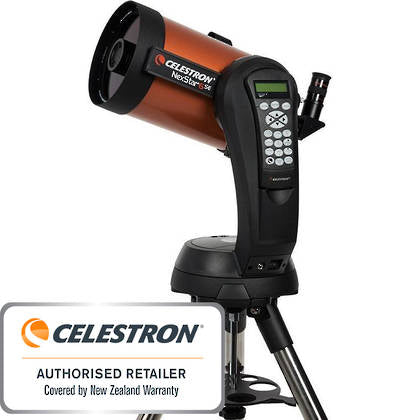
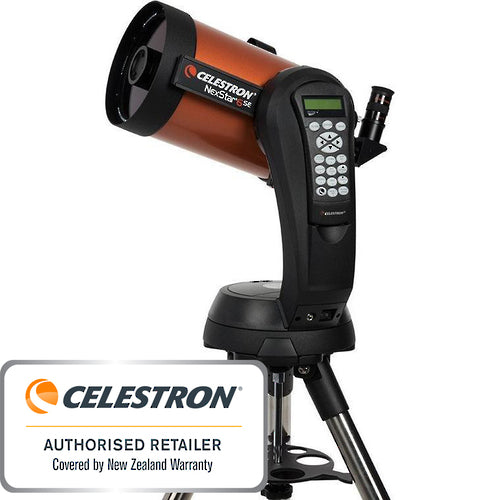
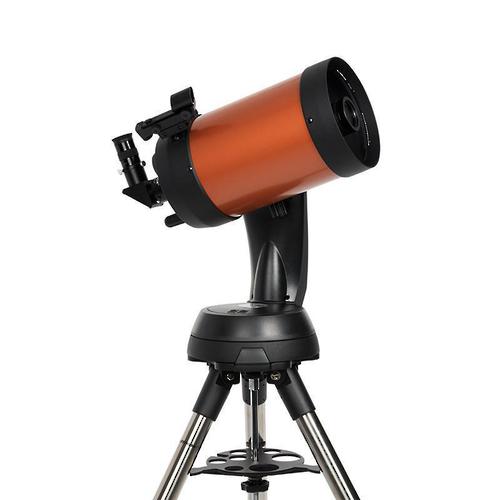


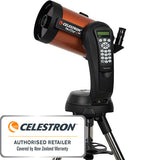
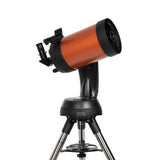
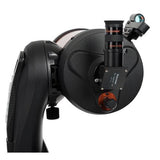
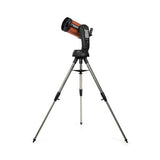

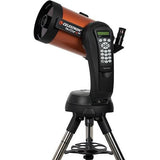

Celestron Nexstar 6SE Computerised Telescope
See Saturn’s rings, Jupiter’s cloud belts and moons, intricate lunar landscapes, bright nebulae and star clusters through 150mm Schmidt-Cassegrain optics, with GoTo finding and automatic tracking built in.
Online store pickup:
- Available from 10 Wilson Rd, Warkworth.
- Usually ready in 12-24 hours
2 Year Limited Warranty
Suitable for adults wanting a high-quality GoTo telescope that’s easy to use
- Description
- Specificatons
- What's in the Box
- Videos
- Downloads
- Reviews
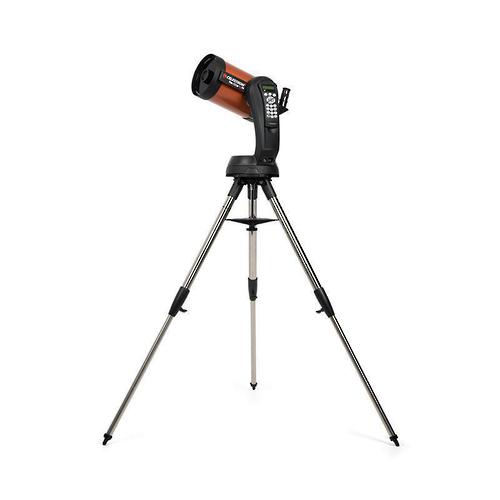
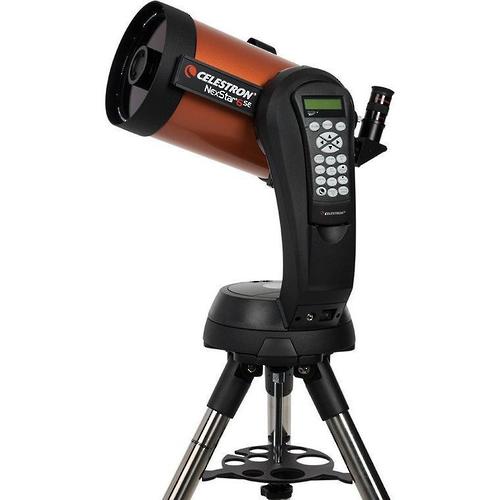
The Celestron NexStar 6SE brings together serious visual astronomy, compact Schmidt-Cassegrain optics and automatic GoTo finding in one of Celestron’s most recognisable orange-tube telescopes.
Its 150mm aperture gives you enough light and resolving power to make the night sky genuinely exciting. Saturn’s rings are unmistakable, with the Cassini Division possible when conditions are steady. Jupiter reveals its four Galilean moons and prominent cloud belts, while Mars can show darker surface markings and polar detail when favourably positioned.
Then there is the Moon. At the eyepiece, crater walls, mountain ranges, central peaks and long shadows transform it from a familiar object in the sky into an extraordinary landscape you can explore feature by feature.
The 6SE is not limited to the Moon and planets. Its 150mm aperture also opens up globular and open star clusters, bright nebulae, double stars and a worthwhile range of brighter deep-sky objects. From New Zealand, Omega Centauri and 47 Tucanae provide magnificent cluster targets, while the Carina and Orion nebulae offer completely different observing experiences.
The Schmidt-Cassegrain design folds a 1500mm focal length into an optical tube only around 41cm long. That gives you useful magnification and a substantial 6-inch aperture without requiring a long telescope tube.
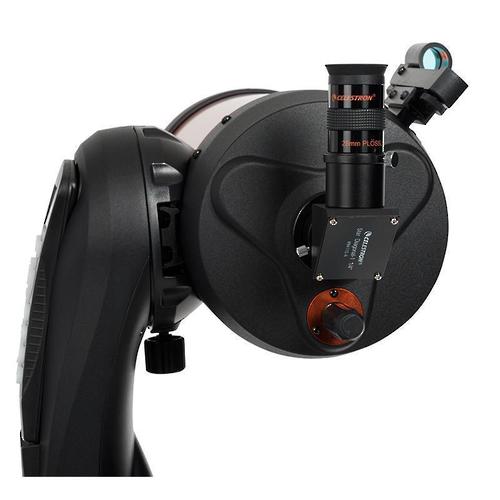
The supplied 25mm eyepiece gives 60x magnification straight out of the box, an excellent starting point for the Moon, planets, clusters and many brighter deep-sky targets. Additional eyepieces can extend the magnification range as your observing develops.
Finding objects is handled by Celestron’s NexStar GoTo system. After a simple SkyAlign procedure, choose an object using the NexStar+ hand controller and the motorised mount moves the telescope towards it. Once centred, tracking follows the target as the Earth turns.
The result is a telescope that lets you spend far more of your evening actually observing — watching Jupiter’s moons change position, studying Saturn’s rings or exploring objects you may never have found manually.
Why Choose the Celestron NexStar 6SE?
- 150mm Schmidt-Cassegrain optics — substantial visual capability in a remarkably compact optical tube.
- Impressive planetary views — explore Saturn’s rings, Jupiter’s cloud belts and moons, Mars and detailed lunar landscapes.
- Rewarding deep-sky observing — discover globular clusters, open clusters, bright nebulae, double stars and brighter deep-sky objects.
- 1500mm focal length — well suited to lunar, planetary and other smaller astronomical targets.
- StarBright XLT optical coatings — Celestron’s enhanced coating system designed to maximise light transmission.
- Automatic GoTo finding — select an object with the NexStar+ hand controller and the telescope moves towards it.
- Motorised tracking — keeps your chosen target in view while you observe.
- SkyAlign technology — align using three bright objects without needing to know their names beforehand.
- Compact single-fork design — substantial optical performance without a long telescope tube.
- 25mm eyepiece included — provides 60x magnification straight out of the box.
- 2-year Celestron warranty.
What Can You See?
The NexStar 6SE gives you a broad and rewarding range of objects to explore.
Saturn is one of the highlights. Its rings are clearly separated from the planet, and under steady atmospheric conditions the Cassini Division between the major rings can become visible.
Jupiter shows its four bright Galilean moons changing position from night to night, together with its prominent atmospheric cloud belts. During particularly good conditions, finer detail can appear across the planet.
Mars becomes most interesting when it is closer to Earth, when darker surface markings and polar detail may become visible. Venus clearly displays its changing phases.
The Moon offers perhaps the greatest variety of all. At higher magnification, individual craters become complex landscapes with terraced walls, central peaks and surrounding ridges, while low-angle sunlight creates dramatic shadows along the lunar terminator.
Beyond the planets, Omega Centauri and 47 Tucanae appear as impressive globular clusters packed with stars. Open clusters reveal bright stellar groupings, while the Carina and Orion nebulae provide luminous clouds of gas surrounding young stars.
Brighter galaxies are also within reach under darker skies, adding an entirely different type of object to your observing programme.
GoTo Finding and Automatic Tracking
The NexStar 6SE does more than tell you where an object is — its motorised mount actually moves the telescope towards it.
Celestron’s SkyAlign system makes initial alignment straightforward. Centre three bright objects in the eyepiece and the telescope determines where it is pointing.
From there, choose a target using the NexStar+ hand controller and the mount slews towards it. Once the object is centred, tracking keeps following it across the sky.
That makes observing at higher magnification considerably more enjoyable and is particularly useful when several people are sharing the telescope. Saturn can remain waiting in the eyepiece rather than needing to be found again for each observer.
Compact Schmidt-Cassegrain Optics
A conventional telescope with a 1500mm focal length could be physically very long.
The Schmidt-Cassegrain design folds that light path inside a tube only around 41cm long, giving the NexStar 6SE its distinctive combination of substantial focal length and compact dimensions.
The enclosed optical tube also helps protect the primary and secondary mirrors from dust and everyday environmental exposure.
FAQ's
Is the Celestron NexStar 6SE suitable as a first serious telescope?
Yes. It combines substantial 150mm optical performance with GoTo finding and automatic tracking, making it approachable for someone new to astronomy while offering enough capability to remain rewarding as their experience grows.
Can I see Saturn’s rings and detail on Jupiter?
Yes. Saturn’s rings are clearly visible, with the Cassini Division possible under good conditions. Jupiter shows its four major moons and prominent cloud belts, with finer atmospheric detail possible when conditions are steady.
Can the NexStar 6SE show deep-sky objects?
Yes. Its 150mm aperture provides rewarding views of star clusters, bright nebulae, double stars and brighter galaxies. Darker skies improve the visibility of fainter deep-sky objects.
Does the NexStar 6SE find and track objects automatically?
Yes. After alignment, select an object using the NexStar+ hand controller and the motorised mount moves towards it. Tracking then keeps the object centred as the sky moves.
Does the NexStar 6SE require power?
Yes. The mount can run from eight AA batteries or a suitable 12V DC power supply. Batteries and external power supply are not included.
*2 Year factory warranty covered by Celestron*
Includes these Celestron Technologies





Compatible with

OPTICAL TUBE INFO: |
|
|---|---|
| Optical Design | Schmidt-Cassegrain |
| Aperture | 150mm (5.91") |
| Focal Length | 1500mm (59") |
| Focal Ratio | f/10 |
| Focal Length of Eyepiece 1 | 25mm (.98") |
| Magnification of Eyepiece 1 | 60x |
| Finderscope | StarPointer |
| Star Diagonal | 1.25" Star Diagonal |
| Optical Tube | Aluminum |
| Highest Useful Magnification | 354x |
| Lowest Useful Magnification | 21x |
| Limiting Stellar Magnitude | 13.4 |
| Resolution (Rayleigh) | 0.93 arc seconds |
| Resolution (Dawes) | 0.77 arc seconds |
| Light Gathering Power (Compared to human eye) | 459x |
| Secondary Mirror Obstruction | 56mm (2.2") |
| Secondary Mirror Obstruction by Diameter | 37% |
| Secondary Mirror Obstruction by Area | 14% |
| Optical Coatings | StarBright XLT |
| Optical Tube Length | 406mm (16") |
| Optical Tube Diameter | 181mm (7.1") |
| Optical Tube Weight | 8 lbs (3.6 kg) |
| MOUNT INFO: | |
| Mount Type | Computerized Altitude-Azimuth Single Fork Arm |
| Instrument load capacity | 12 lbs (5.44 kg) |
| Height adjustment range (includes mount and tripod) | 965.2mm - 1422.4mm (38" - 56") |
| Tripod leg diameter | 50.8mm (2") Stainless Steel |
| Mount Head Weight | 11 lbs (5 kg) |
| Accessory Tray | Yes |
| Tripod Weight | 9 lbs (4.08 kg) |
| Slew Speeds | 9 slew speeds - max speed 5°/second |
| Tracking Rates | Sidereal, Solar and Lunar |
| Tracking Modes | Alt-Az, EQ North & EQ South |
| GPS | N/A |
| Dovetail Compatibility | Vixen / CG-5 dovetail |
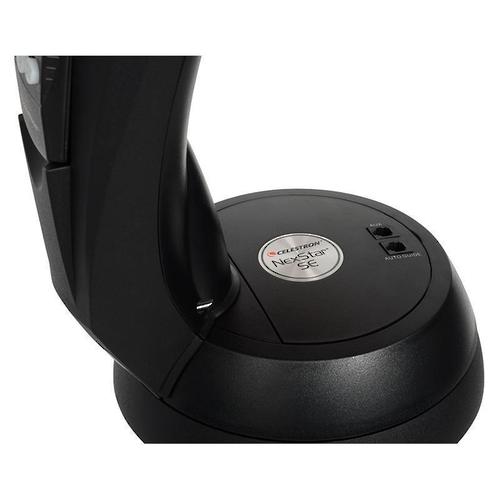
| Number of Auxiliary ports | 1x Aux port |
| Autoguide port | Yes |
| USB port | Yes, Hand Control input |
| Power Requirements | 8-AA batteries (not included) | 12 VDC-750 mA (Tip positive) |
| Motor Drive | DC servo motors |
| Alignment Procedures | SkyAlign, 1-Star Align, 2-Star Align, Auto 2-Star Align, Solar System Align, EQ North / EQ South Alignment (EQ align requires an equatorial wedge) |
| Periodic Error Correction | No |
| Computerized Hand Control | Double line, 18 character Liquid Crystal Display with 19 fiber optic backlit LED buttons |
| NexStar+ Database | 40,000 objects, 200 user defined programmable objects. Enhanced information on over 200 objects |
| Software | Celestron's Starry Night Special Edition Software, SkyPortal App |
| Total Kit Weight | 21 lbs (9.5 kg) |
| Included Items | NexStar SE OTA | Single Fork Arm Mount | Tripod | Accessory Tray | Star Pointer Finderscope | NexStar+ Hand Control | 25mm eyepiece | Star Diagona |
Included Items in the box:
- NexStar SE OTA,
- Single Fork Arm Mount
- Tripod
- Accessory Tray
- Star Pointer Finderscope
- NexStar+ Hand Control
- 25mm eyepiece
- Star Diagonal